
Life across generations
Living culture
Marriage, fields, land, rain, performance and dress connect households with the wider Balobedu nation. These introductions draw mainly on fieldwork published in the 1930s and 1940s. They describe practices recorded then, not a rule for every family today.
01 / Kinship
Marriage in Balobedu tradition
Marriage joined households and created lasting duties among relatives. E. J. and J. D. Krige described munywalo, marriage cattle, as part of a network of reciprocal obligations between a woman’s house, her brother’s house and the households joined through later marriages. In the social pattern they recorded, a cattle-linked cross-cousin was a preferred spouse. This was a specific relationship between linked houses, rather than a preference for marriage to any cousin.
Cross-cousin preference. A contributor expresses the preferred relationship as “Ngwana Rakgwadi o nyala Ngwana Malome”—a child of the paternal aunt marries a child of the maternal uncle. The preference was known in Balobedu and other Northern Sotho traditions, but it describes particular cross-cousin ties and should not be extended to all cousins. The proverb “Dikgomo di boela šakeng” (“the cattle return to the kraal”) conveys how marriage cattle could circulate within connected lineages. Families also valued enduring alliances, known obligations, and continuity of property and care.
Modiba’s account: families, exchange and obligation
In Jack Modiba’s University of Pretoria digitised transcript S.172, the account of older marriage practice lists a sequence of exchanges that includes a spear, a goat, cattle and calves, then further gifts connected with approaching the young woman’s parents and receiving her into the new household (PDF pp. 8–9). The scan makes some of the individual names and quantities difficult to read, so this is a summary of the sequence rather than a definitive inventory.
Modiba says relatives were called together when the bride departed, and elder women accompanied her. Marriage in this account brought the two families into a continuing relationship of recognition and responsibility. His separate account of relatives described as wa rakgadi le wa malome records cattle supplied for a marriage arrangement in the next generation. When that arrangement failed, a disagreement about the cattle went before the chief’s court (PDF pp. 37–38). This is a recorded case illustrating kinship and reciprocal obligations; it does not establish that every cross-cousin marriage followed the same course.
Source: Jack Modiba, transcript S.172, PDF pp. 8–9, 37–38, University of Pretoria digitised collection. View the source note and scan →
Royal households. In the elders’ account shared by a contributor, children of royal houses are called Bakhololo (singular Mokhololo). They were encouraged to marry within another recognised royal lineage. Royal lineages observed stricter protocols when choosing marriage partners because marriage also shaped alliances, inheritance, succession and obligations between houses. The Kriges’ chapter on political institutions describes marriage links around the Queen’s court and the distinctive role of wives in connecting districts and noble houses. Mathekga’s transcripts locate Modika, Mahasha and Mohale in the founding generation and trace the movement of their households; they do not themselves prescribe a general marriage rule. The contributor’s oral history remembers marriages among descendants of Modika, Mahasha, Mohale, Mokoto and other royal branches. These are accounts of historical preference within royal households, not a prescription for every Balobedu family today.
The Rain Queen’s household. In the custom described by elders, a reigning Rain Queen did not enter an ordinary marriage. A noble selected within the royal circle could father her children, while access to her secluded household was governed discreetly by the court. Details treated as restricted by custodians are not set out here. Historical practice and individual reigns varied; the National Museum’s account records a marriage associated with Modjadji IV. A contributor’s oral account links that departure from older expectations to later succession tensions. Elders recall a compromise that emphasised her daughters’ royal descent. The account of the dispute and any allegation of violence against opposing elders need independent corroboration before they can be presented as events established by the archive.
Shalala and the royal house. E. J. and J. D. Krige’s The Realm of a Rain-Queen (1943), pp. 11–12, names Shalala, calls him a commoner and describes conflict between him and the royal house during the reign of Modjadji III. The authors say Magoma, then the queen’s daughter and later Modjadji IV, allied herself with him. This is the book’s account of the dispute, written in the language and interpretive style of its time. The book passage identifies him only as Shalala. Elders contributing to this museum identify him more fully as Shalala Andries Maake, a businessman from Ha-Matipane Village who is remembered as buried outside the royal kraal, and say he fathered Modjadji IV’s children. An elder from his Maake lineage also remembers him as a skilled dancer. They also say Prince Wallace Mokoto of the Mokoto house had been the preferred high-ranking noble for that role. A contributed group photograph names its chairman “W. Mokotu”; it does not establish his proposed role in the queen’s household. The National Museum’s later account names Andreas Maake in connection with Modjadji IV’s marriage. The identification of Shalala as that Andreas Maake, the details of his life and parentage of the children, and the proposed alternative remain attributed to elders’ accounts rather than to the Kriges’ passage.
Mahadi and the kraal. Cattle given as mahadi (bridewealth, called munywalo in the Kriges’ transcription) could help establish a marriage and connect the two families over generations. A saying recalled by the contributor is that “a cow goes back to the kraal.” In this telling, cattle moving through related lineages helped maintain both kinship ties and family wealth. The historical study describes reciprocal cattle and marriage obligations, while the emphasis on strategic wealth preservation is the contributor’s interpretation of that pattern.
Go beka: bringing the bride into the new household
The expression go beka is familiar to Khelobedu speakers in the contributor’s account. A study by University of Pretoria researchers Moiponi Magdalina Sefoka and Mawatle Jeremiah Mojalefa examines its use among Bapedi ba Matlala in Moutse. Their 2021 article treats go beka as a significant final stage of a traditional marriage: after family negotiations and magadi, the bride is formally received into the husband’s family. The authors report that Matlala elders regard a marriage as customarily incomplete until that step has been performed. This is the account of a particular community, not proof that every Balobedu household follows the identical sequence.
The Matlala participants describe a specifically designated cow for go beka, or in some circumstances another agreed gift, which may be delivered with magadi or later. In their account the gift marks the completion of the process, while the bride’s family still has a recognised relationship with and concern for her. The study also records a bride’s return visit to her birth family before her final reception and instruction by women in her new household in some versions of the custom. Its interviewees explain the stage through duties between two families and an ancestral understanding of their union; those explanations are their cultural beliefs.
Crucially, Sefoka and Mojalefa acknowledge that descriptions of go beka vary among writers and interviewees. Their focus is the Matlala community of Moutse; their bibliography includes J. D. Krige’s 1934 study of bridewealth in Balobedu marriage. The shared word offers a useful point of comparison, while the exact Balobedu ceremony, local terminology and contemporary practice should be documented with Balobedu elders rather than inferred from Matlala practice. Read the academic source →
Change and continuity. Migration, wage work, urban life and changing personal choices have altered marriage practices. Some elders believe that departures from customary consultation and kinship protocols contribute to marital breakdown. This is their assessment, not a measured explanation of divorce rates. The museum records it as a living debate alongside the historical account. Families may now arrange their affairs in different ways; a modern financial arrangement should not be confused with the older cultural meaning of marriage cattle.
Sources: E. J. Krige and J. D. Krige, The Realm of a Rain-Queen (1943), chapter I (pp. 11–12) and chapters IV (pp. 52–69), IX (pp. 141–163) and X (pp. 164–185); A. Mathekga, University of Pretoria digitised Lobedu history transcripts S.136, pp. 1–2, and S.179, pp. 3–4; contributor oral account and proverbs; M. M. Sefoka and M. J. Mojalefa, “Go beka: Legato le bohlokwa la lenyalo la setšo,” South African Journal of African Languages 41(2), 2021, pp. 207–213, as a Matlala comparison; P. Davison, University of Cape Town thesis (1991) on matrilateral cross-cousin marriage; National Museum Publications on Modjadji IV. The historical research and the contemporary interpretation are identified separately. Research sources →
02 / Work and exchange
Economy and food production
Field cultivation was central to household life in the period the Kriges studied. They recorded maize as a major staple, alongside older grains including finger millet, sorghum and pearl millet, valued in part for their resilience in dry seasons. Households also kept animals, worked together in agricultural parties, and used beer, cattle and gifts to sustain social relationships.
Modiba’s transcript S.172 also remembers ironworking and the use of iron pieces in exchange, including marriage arrangements (PDF p. 6). This is a historical account of work and value, not a measure of today’s economy. Read the source note →
Wage work, shops, ploughing and restricted access to land were already changing this economy during the researchers’ fieldwork. Present-day livelihoods require their own community accounts and current data.
Source: Krige and Krige, chapters III–IV, pp. 34–69. Source record →
03 / Place and stewardship
Land and local authority
The historical study describes district heads allocating fields and managing local land relations, with disputes sometimes reaching the Queen’s court. It records varying arrangements for residents and people cultivating in another district. Forests, grazing and significant trees also carried communal and royal responsibilities.
These observations concern historical custom, not a statement of present ownership or legal boundaries. The museum will link maps, village histories and commission records when their provenance has been checked.
Source: Krige and Krige, chapter X, especially pp. 181–182; chapter III on cultivation. Source record →
04 / The seasons
Rain making and song
Rain traditions connect the Queenship to agriculture, seasons and the wellbeing of the people. The Kriges described rain making as a continuing institution around the Queen, rather than a ceremony held only during drought. Annekie Joubert’s later study records songs and their performance settings at the royal capital, distinguishing songs honoring the Queen from rain songs performed in particular ceremonial contexts.
Descriptions of restricted rites are presented at a general level here. Community custodians should guide any future publication of ceremonial detail.
Sources: Krige and Krige, chapter XV, pp. 271–281; A. Joubert, “Rain songs and the observance of the rain cult amongst the Lobedu people of Queen Modjadji,” South African Journal of African Languages 31(1), 2011, pp. 6–16. Research record →
05 / Performance
Traditional dances
Dance and music appear in historical accounts of work parties, celebrations and ceremonial gatherings. The Kriges recorded drumming, singing and masked performances, including the duhwera at Rabothata. Joubert’s work follows rain songs and associated movement, including the legobathele dance. Names, meanings and who may perform can vary by place and occasion; future recordings should identify performers and custodians.
Sources: Krige and Krige, chapter IV, pp. 52–69, and chapter VIII, pp. 126–140; Joubert (2011), pp. 6–16. Research record →
06 / Dress and identity
Attire and royal symbolism
Photographs from the Kriges’ 1930s fieldwork show clothing in a period of change: women in cloth wraps and cloaks, and many men in factory-made shirts and trousers. Clothing should be dated and attributed when used to represent Balobedu life. The family account names the black attire Morina and describes it as the foundation of contemporary designs, with beadwork at the centre. See Morina in the photo gallery → The leopard-skin motif in this museum’s design evokes Ma apara Nkwe (“those who wear leopard skin”). The skin is also called Lethebo in the family account; it is a symbol here, not a claim that everyone dressed alike.
Sources: A. Bank, “Visualizing the Realm of a Rain-Queen,” Kronos 38(1), 2012; family account supplied for the museum. Read the research article ↗
Morina · a living expression
Black cloth, beadwork and identity
In the family account shared for this museum, Morina is the Khelobedu name for the black attire and the foundation from which many contemporary Balobedu designs draw. The black cloth gives the beadwork and bright bands a clear ground. White beads, sometimes threaded with small fields of colour, appear at the head, shoulders, wrists, waist and hem in the photographs contributed to the gallery.
The beadwork is central to the look: it frames the cloth, moves with the wearer and displays the care of making and wearing it. A headband, cuff, sash, bag or decorated edge can carry the same visual language even as cuts, fabrics and ways of dressing change. The gallery shows wraps and drapes alongside tailored dresses and coordinated contemporary outfits. These are living interpretations, not one fixed uniform for every period or occasion.
In this museum’s design, the dark header and narrow white and multicoloured line are drawn from the Morina garments and beads. They invite visitors to encounter Balobedu identity before reading the historical text. Specific meanings of bead colours or arrangements should be documented with their makers and wearers rather than assigned without testimony.
Source: family account and contributed photographs. The identification of Morina as the foundation of contemporary designs is the contributor’s account. Individual makers, dates and occasions will be added as they are established.
Explore the Morina gallery →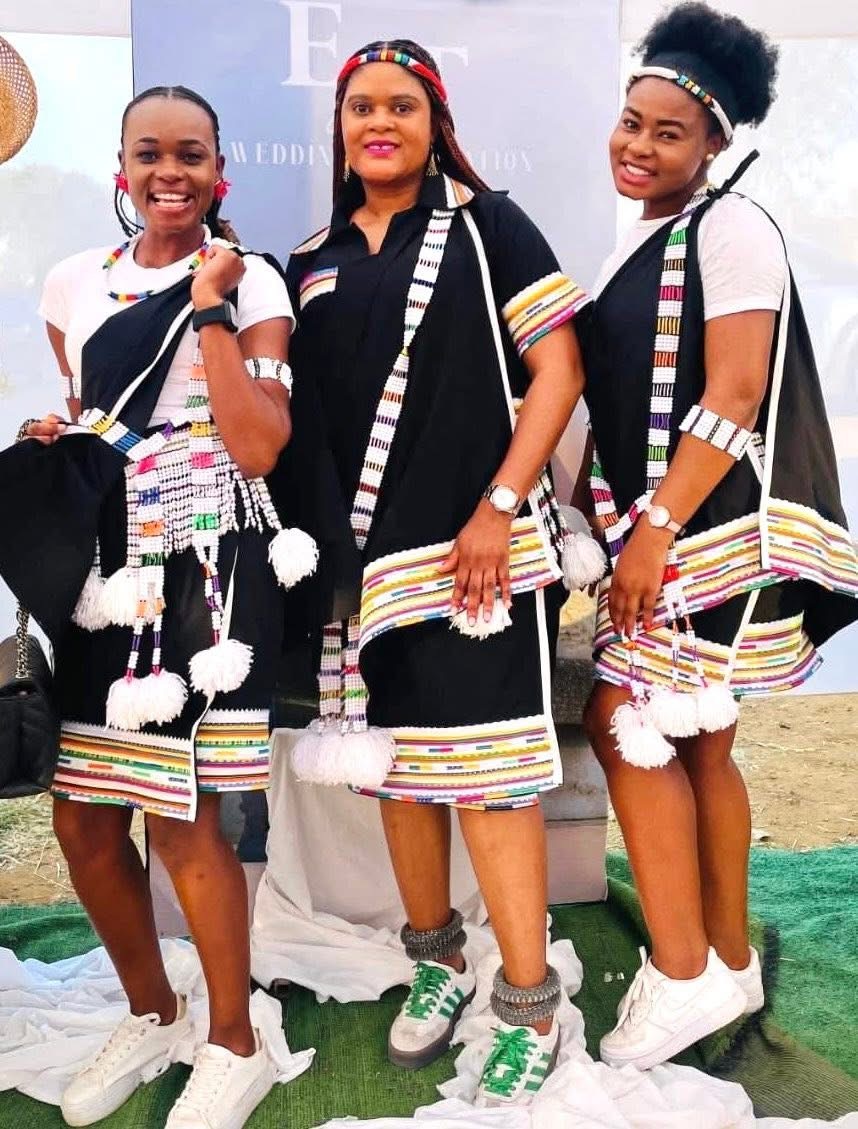
People and performance
A gallery of Balobedu attire
Photographs of dress, beadwork and dance show living expressions of culture across generations.
View the gallery →Contribute to the record
Many local expressions
These chapters are a starting framework. Oral accounts, village-specific practices, names in Khelobedu and dated photographs can deepen and correct them. Each future item should identify its source and consent for publication.
Explore the academic archive →